


The short answer
Most warming drawer problems come from a failed heating element, a faulty thermostat or temperature sensor, a control board or switch issue, or worn drawer slides. All of these are usually repairable without replacing the unit. A technician can test each part on site and tell you whether a repair makes sense before any work starts.
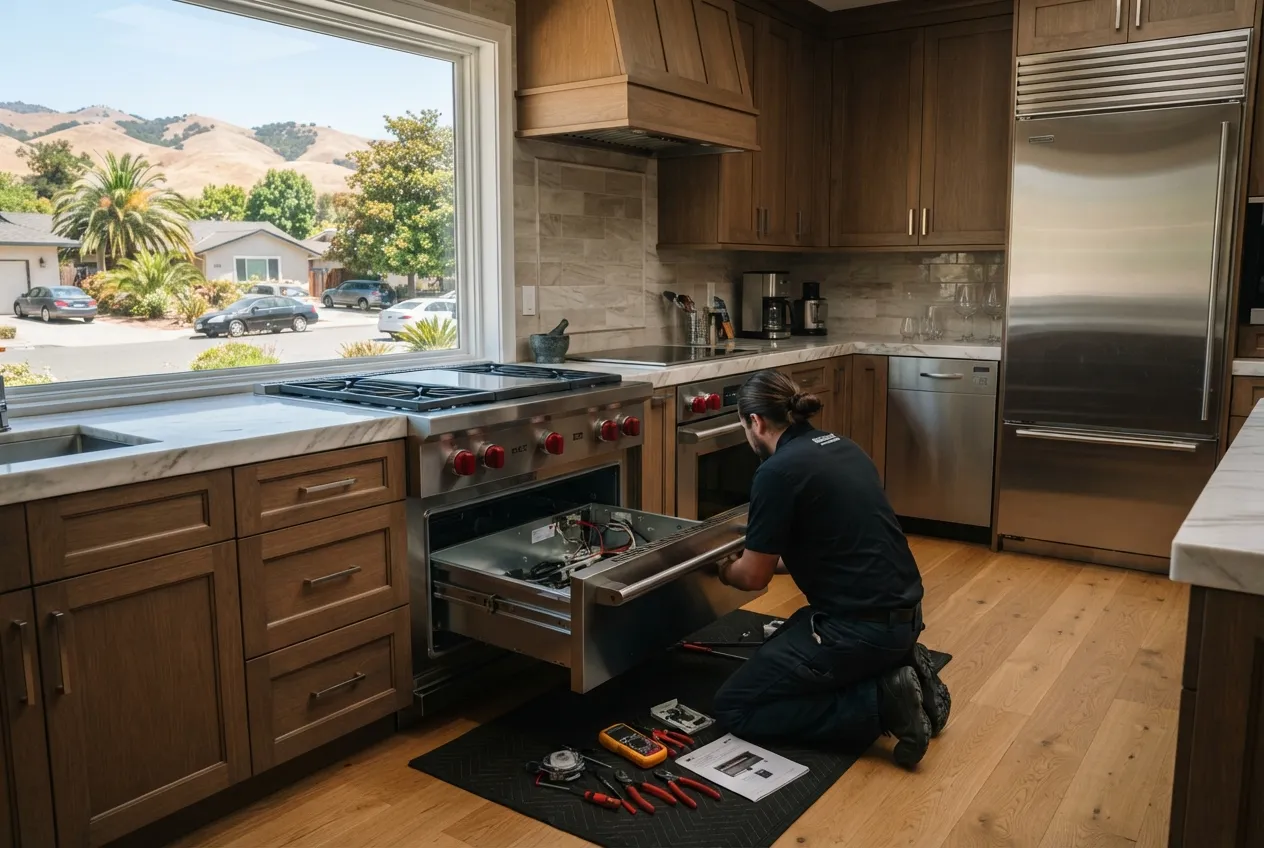
A warming drawer is easy to overlook until it stops working. Then dinner rolls come out cold, plates stay at room temperature, and the drawer that was built into your cabinetry becomes dead space. Wolf Appliance Services repairs built-in and professional-style warming drawers in San Jose and nearby cities. We work mostly on Wolf units, along with Viking and Thermador, and often in kitchens built around Sub-Zero refrigeration. Our technicians find out why the drawer isn't heating, holding temperature, or sliding the way it should, then explain what it will take to fix it. We are an independent repair company and are not affiliated with any appliance brand.
Issues we fix
Warming drawers have fewer parts than an oven, so symptoms usually point to a short list of causes. These are the problems homeowners call us about most often:
- Drawer doesn't heat at all, even though the indicator light or display comes on
- Drawer gets warm but never reaches the set temperature
- Food comes out too hot, dried out, or overcooked at a low setting
- Uneven heat, with one side or the back of the drawer noticeably cooler
- Control knob, touch panel, or on/off switch that doesn't respond
- Indicator light that stays off, flickers, or stays on after the drawer is turned off
- Breaker trips or the unit shuts off on its own
- Humidity or moisture control that no longer changes how food holds
- Drawer that sticks, sags, won't close fully, or comes off its slides
- Burning smell or visible damage near the heating element
What our technician checks
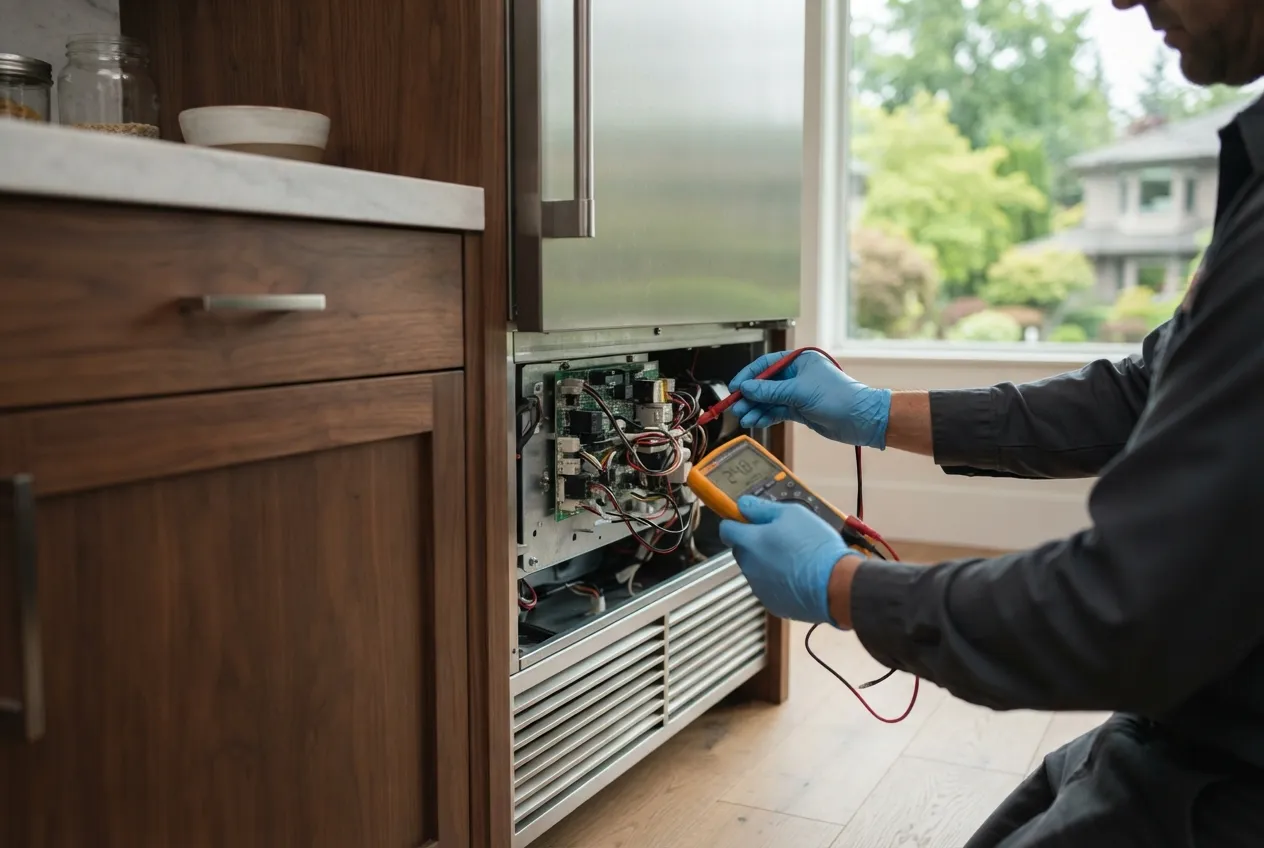
On a built-in or professional-style warming drawer, we start with the basics: power at the outlet or junction box, the breaker, and any wiring connections behind the unit. A surprising number of no-heat calls come down to a loose connection or a tripped circuit after other kitchen work.
From there, we test the heating element for continuity and look for signs of breaks or scorching. We check the thermostat or temperature sensor against the actual drawer temperature, since a sensor that reads wrong will make the drawer run too hot or shut off too early. We test the control knob, switch, or touch panel, and on electronic models we check the control board for fault behavior.
We also look at the mechanical side. That means the drawer slides and rollers, the gasket around the drawer front, the humidity vent if your model has one, and how the unit sits in the cabinet opening. A drawer that doesn't seal well loses heat and makes the element work harder.
How Wolf, Sub-Zero, Viking and Thermador kitchens differ
Wolf warming drawers are common in the high-end kitchens we see around the South Bay. Many have a moisture control that lets you choose between moist and crisp settings, so a vent that sticks or a control that won't change settings is a typical complaint, along with element and sensor failures. Because these drawers are often installed under a Wolf wall oven or in a cabinet run, access and alignment matter during repair.
Sub-Zero focuses on refrigeration rather than warming drawers. In practice, many homeowners with Sub-Zero refrigerators have a matching Wolf warming drawer, and we service the whole cooking side of those kitchens.
Viking warming drawers tend to have straightforward controls, so failures usually come down to the heating element, the thermostat, the indicator light, or the drawer glides on older units that see daily use. Thermador warming drawers often use electronic or touch controls on newer models, so a control panel or board fault is more likely to be part of the diagnosis there, alongside the usual element and sensor issues.
Tell us what your appliance is doing.
Repair or replace a high-end warming drawer?
For most premium warming drawers, repair is the sensible choice. The core parts, such as the element, sensor, switches, and slides, can usually be replaced individually, and a well-built drawer can keep working for many years after a part fails.
Replacement makes more sense when the cabinet or drawer box itself is damaged, when parts for an older model are no longer available, or when several major components have failed at once. Size matters too. Built-in drawers are fitted to a specific cabinet opening, and a new unit may not match the old dimensions or the panel design. That can turn a simple swap into cabinetry work. We'll tell you plainly which way we'd lean and why, so you can decide.
What affects the cost of a repair
We can't quote a repair before seeing the unit, but these factors shape what it will take:
- The fault itself: a loose wire or tripped circuit is a smaller job than a failed control board
- Parts: some components are stocked widely, while others for older or less common models take time to source
- Access: drawers set into custom cabinetry, under a wall oven, or behind a fitted panel take more time to remove and reinstall
- Panel-ready fronts: custom wood panels have to be handled carefully to avoid damage
- Multiple failures: an overheating problem can damage wiring or the gasket along with the original part
How a visit works
When you contact us, we'll ask for the brand, model if you have it, and what the drawer is or isn't doing. That helps the technician come prepared. We schedule a visit at your home in San Jose or a nearby city.
At the appointment, the technician tests the unit, explains what failed, and goes over your options before doing any repair work. If the part is on hand, many repairs can be finished the same visit. If a part needs to be ordered, we'll explain the next steps and schedule a return trip. Before leaving, we run the drawer to confirm it heats and holds temperature correctly.